
I.
8am.
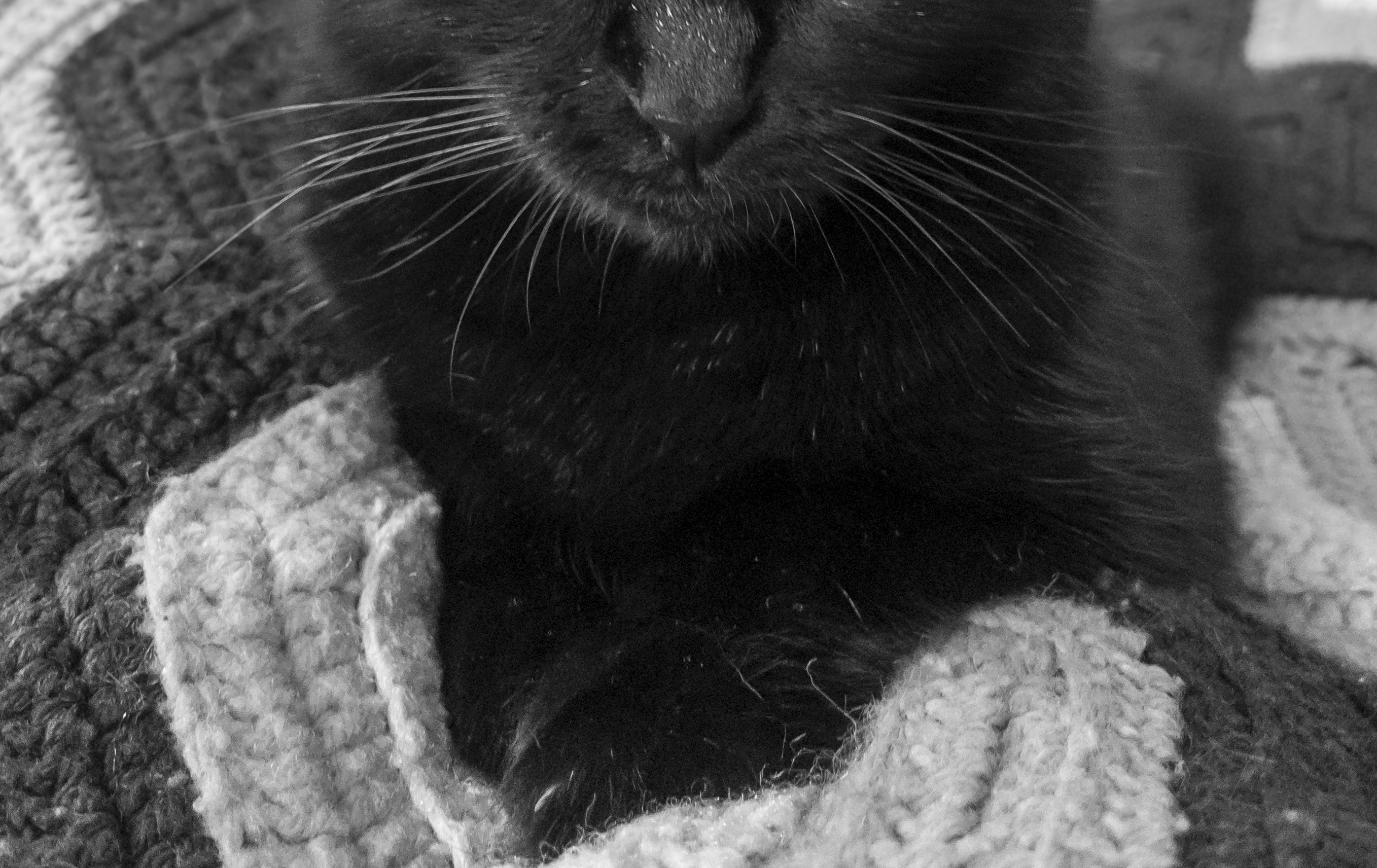
The cat on the porch is alive.
The cat inside nudges my hand
like a dead bird.
Her name is Theodora.
She begs the corpse
for breakfast
This time of day I’m no good at anything—
I fill her bowl with brown pellets
until they tumble on the wooden floor.
Her secret language consists chiefly
of requests.
Two years and I’m still learning her expectations
are the result of certain concessions.
For example,
in exchange for her freedom
to hunt tree birds and wild rodents
she tolerates the daily feedings
of mummified bits.
She declines a view of the big
blue marble
but saves
the commissary ticket.
Sometimes before meals
when I have her attention
I inquire
her satisfaction in our arrangement;
whether it is mutually consented or
merely implied.
She never answers.
Her language is secretly very
simple.
She whacks pellets into a pile
of shit.
II.
In my half of the duplex
there’s no room for a dining table.
I sit on the porch
spooning a mason jar of cold oatmeal
like a true proletariat.
Sunlight diffuses managerially across
aluminum cloudlines.
Cars passing blow
loose spring pins
in my eyes.
An electronic billboard from the nearby preparatory
never turns off.
Screens switch between faces of electronic
children in summer uniforms.
In their eyes I look for signs of melancholy.
This my winter tradition.
Today I am the local expert on concealed
grief.
How easy it is to miss
when unaccustomed to its gambits.
In general, adults are more melodramatic.
Their melancholy is catastrophic
like a nuclear missile.
Sometimes soundless as a gnat
in an old master painting of cheese wheels
and summer peaches.
Psychologists can tell whether a child is
depressed
by the way they draw the sun.
III.
Friday.
I sit at my parent’s kitchen table revisiting
Diane Seuss,
when my father asks if I am depressed.
What he really wants to know are the ways
he depresses me.
He thinks misery stunted my
maturation.
Maybe he’s right.
I have always been miserable
in the exact same way.
Sunday.
Returning to Seuss
and her wicked toys.
The words dubious lexicon
underlined
in black ink.
IV.
The stray turned up yesterday
before M. and I headed east toward
Gun Barrel City.
We were picking up an antique bed frame.
M. says it’s probably domesticated.
You can tell by the temperament of sweetness,
how it accepts all our hands.
It’s still there when we return
hours later:
another sign of domestication.
Today I find it
turned inside a heavy-duty plastic tub
insulated with paper confetti
and the plaid scarf from M.
I never wore anyway.
Its eyes look up at me from
the edge of the container.
A seasick stowaway peering from the hull
until the ocean blinks.
V.
I have always been confused
by feline heredity.
A single litter can produce kittens
of many coats.
The internet explains this fact through many factors
including
the possibility of multiple fathers.
One to an egg.
She screams after each one finishes.
There are no accounts of the mother
besides description of heat.
The vulva swollen into a cyclopean eye
or returning with dinner
to one less than before.
The one with the marshmallow coat
and pink nose.
The internet says something about changes
in behavior, in appetite.
A marble table with six glasses of rotting milk.
the internet says nothing whatsoever
about guilt.
VI.
I am trying to assemble November into a trendy leather sofa.
It is by no means easy. The instructions are carved into a
gravestone on the far side of the cemetery; the side where
they bury children. You can barely hear yourself think over the
chrysanthemums. I am trying to assemble a contemporary art
instillation titled A Series of Porches. A group of curators stop
by; complimenting the stray’s realism. They say things
like How did you get it to look so cold? You’re like Da Vinci
with a melting popsicle. I am trying to define series of
unrelated phenomena by online shopping habits. I am trying
to recommend interior design styles based on your
astrological sign. Mid-century reproduction. No. Eco-
deforestation. I am trying to respond to your texts. You don’t
understand; I am juggling a lot of plates right now; my hands
are in
a lot of buckets; there’re no more buckets and the roof keeps
leaking. I am trying to get out of Dallas before next year.
Something terrible happens next year. Mostly, I am turning
25; they’re going to tear me down and build luxury
apartments. I am trying to stay within standards for ethical
labor. I am trying to reach the nearest no-kill shelter but
they’re too damn closed.
VII.
Joni gets it. The cold not necessarily succeeded
by colder.
It’s a ritual of mine
dropping the needle on her jet-black grooves
when I’m too chilled
to leave the house.
On the front of the record is a photograph
of Joni in a slouchy black
beret and overcoat.
Her cheekbones shadowed by chiaroscuro
arrowheads. Joni’s right hand appears
out of the clouds
over a two-lane highway.
I haven’t spoken to anyone all day.
On Sundays I practice disappearing
then reappearing,
over and over. My mother calls in the middle of
vanishment—
I let it go to voicemail.
She wants to discuss the question
of the stray.
It left hours ago for another porch.
I slide the record out of its sleeve
then set it on the turntable.
The real miracle is Jaco’s eternal bass line.
Its freedom startles me.
In the contained and metallic way freedom appears
to us freeless.
Joni had no issue with sounding defeated
when she sang.
Her issue came down to tasteful assemblies
of defeated answers.
The road is one answer
for the heart’s irrationality.
It requires the mind’s complete submission,
akin to dreaming.
Thinking itself alone,
the heart opens.
VIII.
I mostly drive for music
and to get away
from the mind’s heedlessness.
Today I drive for many reasons.
I’m driving to
a friend’s apartment for drinks and a movie.
Only a quarter until six
and the sky is all midnight.
It seems to get dark earlier and earlier
these days.
Don’t listen to me.
These are only ramblings
of a shut-in.
Dallas offers little
in the way of roadside attractions.
Still
the track is a vibe.
For the past week I’ve listened Cowboy Junkies
to death.
I put them on anyway.
I wonder what Lou thought of their soporific take
on “Sweet Jane.”
It barely exists
where Lou very much existed.
Now he’s dead.
Oh don’t get me wrong—
the dead still exist
if you crank the lower frequencies.
On days
when I take her to the veterinarian office
Theodora meows insistently
from the passenger seat
so I can barely hear the chorus.
I used to think it was unfounded:
her fear of leaving.
Now I’m less confident.
Sure. Her heart opens
same as you and I;
same as you
and I, the heart opens.
We don’t always dig its tune.
IX.
It’s no secret
why quietness follows cold fronts—west
to east—according to established patterns
of circulation. Even strays know
the acoustic effect of density.
It is the same everywhere.
You cannot escape it
no matter how close you are to the speaker;
the cord’s severed.
L. came into Dallas from Austin
a few days back.
Since his mother died, he’s lived
in her house executing
the estate.
Last winter when she was still alive
the ceiling collapsed over the living room.
The room froze
into a pile of dirty dishes.
L. is sitting on the bean bag sofa when I come in.
He’s much the same as before.
His eyes pass over me not landing anywhere
in particular. I have observed this pattern before;
men well-trained in scanning
the surface of a well-swimmed lake
but not its depth.
Something happened on New Years between L. and I.
It doesn’t matter now
I’m a waterbody.
He’s brought a cat he adopted last month
on the Lower East Side.
He’s hung up on the question
of the right name.
I say It’s not about being right
It’s about being sure.
Cats respond better to the unrounded vowel.
For example the long-e in need
or freeze—
behaviorists suggest the high-pitched sound reminds
them of prey.
They are lifelong hunters.
I say it’s about being very small,
enough to get caught.
We watch a movie about Kennedy and Elvis
hunting a mummy
in an East Texas rest home.
There’s not much to say except
Kennedy is black
and Elvis is a phony.
All evening I tell no one about the cat
or the porch.
When someone asks about my day
I vanish completely.
I don’t reappear until I’m home.
The stray is vanished.
Theodora investigates dinner plans.
The sink is full of dishes
but the roof
is strong.
Harrison Blake (b. 2001) is a poet and arts writer based in Dallas, TX. Blake received a BA in Visual and Performing Arts from the University of Texas at Dallas with a concentration in Art History. In their poems they often explore memory, desire and transfiguration through language.
Blake’s writings appear and are forthcoming in digital and print publications including The Nasher Magazine, Southwest Contemporary, F Magazine, Sugar House Review, Driftwood Press, new words {press}, Just Keep Up Magazine and Glasstire.
Leave a Reply